Especially for the family members of The Shriram Millennium School, Noida - This is a space that you can call your own. Students and teachers are welcome to send in their posts to make this space more beautiful.
We have studied the verses of the great poet Sur Das . Here are some clips. I am sure you will enjoy these musical verses written by Sur Das Ji. The first ,in fact,is a very popular one.
Dear Children, We hope you will enjoy the story given below , written by a renowned Russian author Count Lev Tolstoy. Let me know how you liked it. Regards, Pratibha Ma'am [लेव टाल्सटॉय (१८२८-१९१०) रूस के उन प्रसिद्ध साहित्यकारों में से हैं जिनके उपन्यास ‘वार एंड पीस’ और ‘अन्ना कार्निना’ को विश्व के दस सर्वश्रेष्ठ उपन्यासों में गिना जाता है। उनके लेखन तथा अहिंसा के सिद्धांतों से महात्मा गांधी और मार्टिन लूथर किंग जूनियर प्रभावित थे। उनकी कहानी ‘थ्री क्वेश्चन्स’ का भावानुवाद प्रस्तुत है।]
बहुत समय पहले की बात है जब एक रियासत के राजा के मन में यह विचार आया कि अच्छे प्रशासन के लिए क्या किया जाए। उसने सोचा कि कितना अच्छा हो यदि यह पता चल जाए कि किस कार्य को पहले करना चाहिए, उसे करने के लिए कौन-सी शुभ घड़ी होती है और किस विद्वान की सलाह पर कार्य सफल होता है। ऐसा विचार आते ही उसने राज्य में मुनादी फिरा दी कि जो कोई उन्हें सही समय पर सही कार्य करने के लिए सही व्यक्ति के बारे में सही सुझाव देगा, उसे पुरस्कृत व सम्मानित किया जाएगा। कई विद्वानों ने राजा के दरबार में आकर अलग-अलग सुझाव रखे। कोई कहता कि सही समय के लिए पहले से ही निर्धारित कार्यक्रमानुसार कार्य करना उचित होगा; ऐसे कार्यक्रम द्वारा ही कार्य सुनियोजित समय पर पूर्ण करना सम्भव होगा। कोई और कहता कि कार्यक्रम बनाने से समय को नियंत्रित नहीं किया जा सकता। समय को बेकार नहीं गँवाना चाहिए और जिस समय जो कार्य अधिक मुख्य लगे, उसे पहले करना चाहिए। कुछ और कहने लगे कि राजा कितना भी सतर्क और सक्षम हो, एक व्यक्ति हर समय हर कार्य पर नज़र नहीं रख सकता; इसलिए उसे बुद्धिमान लोगों का एक दल बनाना चाहिए जो राजा को सही समय पर सही कार्य करने का सुझाव दे सके। कुछ पंडितों का सुझाव था कि मंत्रियों का एक दल बनाया जाए तो कुछ और ने कहा कि भविष्य में क्या होगा इसकी जानकारी तो किसी भविष्यवक्ता को ही होगी, इसलिए भविष्यवाणी करने वालों की सहायता से ही राजा को सही समय की जानकारी मिल सकती है। इसी प्रकार दूसरे प्रश्न पर भी कुछ ने मंत्रियों की नियुक्ति का सुझाव दिया तो कुछ ने पंडितों या चिकित्सकों या सैनिकों की सहायता लेने का प्रस्ताव रखा। मुख्य काम कौन सा है? इस प्रश्न पर किसी ने कहा कि विज्ञान मुख्य है तो किसी ने युद्ध और कुछ अन्य ने भक्ति को प्राथमिकता दी। सभी के अलग-अलग उत्तर मिले परंतु रजा को कोई सुझाव नहीं भाया और उसने किसी को भी पुरस्कृत नहीं किया। उसके मन में उत्तर खोजने की जिज्ञासा तीव्र होने लगी। उसे पता चला कि एक ज्ञानी ऋषि जंगल के एक आश्रम में वास करते हैं। उसने तय किया कि वह उनसे इन प्रश्नों का उत्तर माँगेगा। उसे पता था कि यह ऋषि न किसी से मिलते हैं और न ही आश्रम छोड़कर बाहर कहीं निकलते हैं। इसलिए उसने तय किया कि जंगल के उस आश्रम में वह एक साधारण व्यक्ति की तरह ही जाएगा। साधारण वेशभूषा में राजा जंगल की ओर निकल पड़ा। जैसे ही वह आश्रम के करीब पहुँचा, उसने अपने सैनिक दल को वहीं रुकने को कहा और वह अकेला आश्रम की ओर चल पड़ा। आश्रम पहुँच कर राजा ने देखा कि एक वृद्ध आँगन में खुदाई कर रहा है। राजा ने उसे प्रणाम किया। उस वृद्ध ने प्रणाम का उत्तर दिया और अपने काम में लग गया। एक सूखी काया के इस श्रम को देख कर राजा ने सोचा कि वह खुदाई करते करते थक गया होगा तो क्यों न उसकी सहायता कर दी जाए। सहायता के लिए आगे बढ़ते देख कर भी वृद्ध अपने कार्य में जुटा रहा। राजा पास जाकर नम्रतापूर्वक बोला- "हे ऋषिवर, मैं आपके पास तीन प्रश्नों का उत्तर माँगने आया हूँ। मैं कैसे जानू कि सही कार्य के लिए सही समय कौन सा होगा और उस कार्य की सफलता के लिए कैसे कार्यकर्ता हों?" ऋषि ने कुछ उत्तर नहीं दिया और अपने काम में ही लगा रहा। राजा ने कुछ देर के बाद कहा-"आप थक गए होंगे। लाइये, यह कुदाल मुझे दीजिए, मैं आपकी मदद कर दूँ। आप थोड़ी देर विश्राम कर लीजिए।" ऋषि की सांस फूल रही थी। उसने राजा को कुदाल दे दी। कुछ देर खुदाई करने के बाद राजा ने अपने प्रश्न फिर दोहराए। ऋषि उत्तर देने की बजाय बोले- "लाओ, तुम थक गए होंगे, कुदाल मुझे दे दो और आराम करो।" परंतु राजा ने खुदाई का काम जारी रखा। शाम ढलने लगी। राजा अपना काम जारी रखते हुए फिर कहा-"आप ज्ञानी हैं, इसलिए मैं अपने प्रश्नों का उत्तर जानने के लिए आपके पास आया हूँ। यदि आप उत्तर न देना चाहें तो खाली हाथ लौट जाऊँगा।" "वो देखो, कोई दौड़ता हुआ इधर आ रहा है। देखें, कौन है!" कहते हुए ऋषि उठ खड़े हुए। राजा ने उस ओर मुड़कर देखा। एक व्यक्ति अपना पेट पकड़े आश्रम की ओर दौड़ा चला आ रहा था। उसके शरीर से खून बह रहा था। जब वह राजा के पास पहुँचा तो कराहते हुए गिर पड़ा और बेहोश हो गया। ऋषि और राजा ने मिलकर उसके वस्त्र ढीले किए तो उसके पेट से खून चू रहा था। राजा ने उसके ज़ख्म को धो दिया और अपने रुमाल से उस खून के बहाव को दबाने का प्रयास किया। जैसे ही रुमाल खून से लथपथ हो जाता, उसे पानी से धोकर फिर पेट के उस ज़ख्म पर रख देता। ऐसा उसने कई बार किया। अंततः खून का रिसाव बंद हुआ। राजा ने उस व्यक्ति के चेहरे पर पानी के छींटे मारे और दो घूँट पानी पिलाया। अंधेरा छा गया था। घायल व्यक्ति को आश्रम के भीतर ले जाकर लिटा दिया गया। राजा भी बहुत थक गया था। एक तो लम्बा सफर और फिर आश्रम में किया गया परिश्रम। उसे भी नींद आ गई और वह भी वहीं सो गया। सुबह नींद खुली तो उसे कल का सारा घटनाक्रम याद आया। उसने आँख खोलकर देखा तो वह घायल व्यक्ति उसकी ओर देख रहा था। धीमे स्वर में वह घायल व्यक्ति कह रहा था-" मुझे क्षमा करना।" "मैं तुम्हें जानता भी नहीं; तो फिर, क्षमा किस बात की?" "आप मुझे नहीं जानते, पर मैं आपको जानता हूँ। आपके उस दुश्मन का भाई हूँ जिसे आपने मार दिया और उसकी सारी सम्पत्ति छीन ली थी। मैंने प्रण लिया था कि मैं भी आपकी हत्या करके बदला लूंगा। इसी इरादे से मैं आश्रम की ओर आ रहा था। रास्ते में आपके सिपाहियों ने मुझे पहचान लिया और मुझ पर आक्रमण कर दिया। किसी तरह जान बचा कर भाग आया था। यदि आपने मेरा उपचार न किया होता तो मर ही जाता। इस जीवनदान के लिए मैं आपका ऋणी हूँ और जीवन भर आपकी सेवा में रहूँगा। मुझे क्षमा कर दीजिए।" राजा प्रसन्न हुआ कि उसके एक दुश्मन से आज सुलह हो गई। जब वह आश्रम से बाहर निकला तो ऋषि को आंगन में बीज रोंपते हुए देखा। अंतिम बार अपने प्रश्नों का उत्तर जानने के लिए वह ऋषि के पास पहुँचा और उत्तर की प्रतीक्षा करने लगा। कुछ रुककर ऋषि ने कहा-"तुम्हारे प्रश्नों का उत्तर तो मिल गया।" "वो कैसे? क्या मतलब?" "तुम ने देखा नहीं! यदि तुम मेरी थकी हालत पर रहम खाकर मेरी सहायता न करते और लौट जाते तो वह व्यक्ति तुम पर आक्रमण करता। तब तुम्हें पछतावा होता कि रुक जाते तो इस आक्रमण से बच जाते। तो सही समय वह था जब तुम रुक गए और मेरे प्रति तुम्हारी सहानुभूति व सहायता मुख्य कार्य बन गए। बाद में, जब वह घायल व्यक्ति हमारे पास आया तो वह समय और उसकी सहायता मुख्य हो गए। यदि तुम उसकी सहायता न करते तो वह तुम्हारा मित्र बनने से पहले ही मर जाता। तो उस समय वह व्यक्ति मुख्य था और जो तुमने किया वह मुख्य कार्य था। याद रखो, समय वही मुख्य होता है जब तुम्हारे पास शक्ति है, मूख्य व्यक्ति वही होता है जो तुम्हारे साथ खड़ा है और मुख्य कार्य वही है जब तुम उसकी सहायता में जुटे हो क्योंकि नियति ने उसे तुम्हारे पास इसीलिए तो भेजा था।" एक ही समय महत्वपूर्ण होता है और वह समय है जब हमारे पास कुछ करने की शक्ति है, वह व्यक्ति महत्वपूर्ण है जो उस समय तुम्हारे पास है- भले ही तुम उसे नहीं जानते कि उससे भविष्य में संपर्क रहे न रहे, और सबसे महत्वपूर्ण कार्य यह है कि तुम उसकी भलाई करो क्योंकि मनुष्य को केवल यही कार्य के लिए यह जन्म मिला है।
Happy New Year!
Let's learn a little about Mensuration . Watch the video below and let me know what you think.
Have you ever wondered why we need to learn geometry ? Well, there are lots of reasons. In fact, there are many professions which cannot do without geometry at all . Click on the link below to know what are the careers that require geometry-
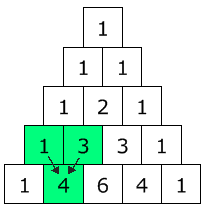
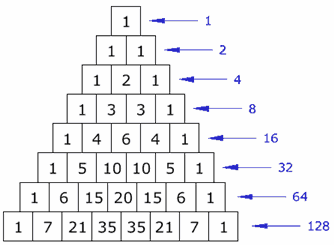
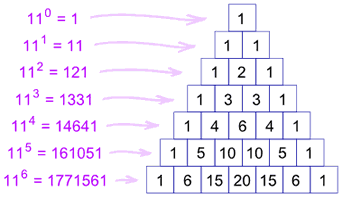
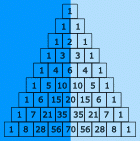
Prepare to be surprised to discover how versatile Pascal's triangle is. Amazing and amusing at the same time - exploring Pascal's Triangle will lead you down an unforgettable path. Don't forget to tell your Math teacher about what you learnt from this.
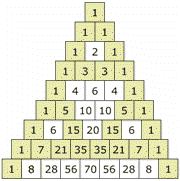
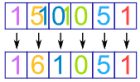
But what happens with 115? Simple! The digits just overlap, like this:
The same thing happens with 116etc.
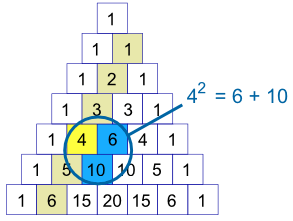
Squares
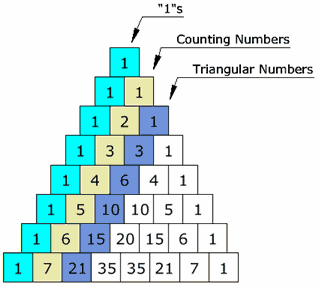
For the second diagonal, the square of a number is equal to the sum of the numbers next to it and below both of those.
Examples:
32 = 3 + 6 = 9,
42 = 6 + 10 = 16,
52 = 10 + 15 = 25,
...
There is a good reason, too ... can you think of it?
(Hint: 42=6+10, 6=3+2+1, and 10=4+3+2+1)
Fibonacci Sequence
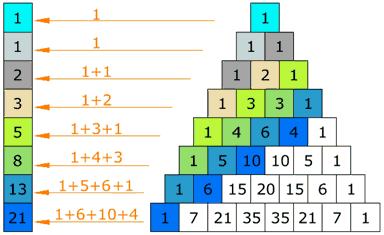
Try this: make a pattern by going up and then along, then add up the values (as illustrated) ... you will get the Fibonacci Sequence.
(The Fibonacci Sequence starts "0, 1" and then continues by adding the two previous numbers, for example 3+5=8, then 5+8=13, etc)
Symmetrical
And the triangle is also symmetrical. The numbers on the left side have identical matching numbers on the right side, like a mirror image.
Using Pascal's Triangle
Heads and Tails
Pascal's Triangle can show you how many ways heads and tails can combine. This can then show you the probability of any combination.
For example, if you toss a coin three times, there is only one combination that will give you three heads (HHH), but there are three that will give two heads and one tail (HHT, HTH, THH), also three that give one head and two tails (HTT, THT, TTH) and one for all Tails (TTT). This is the pattern "1,3,3,1" in Pascal's Triangle.
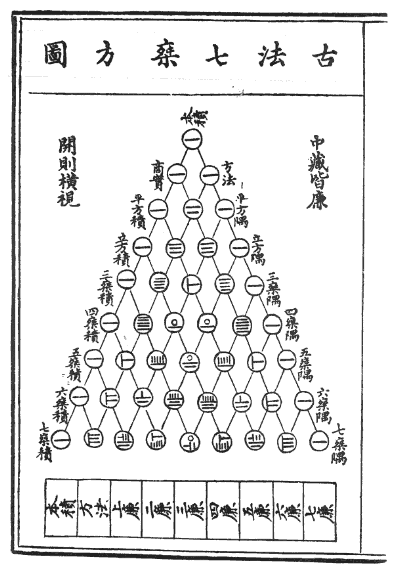
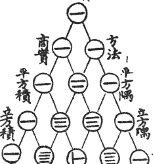
This drawing is entitled "The Old Method Chart of the Seven Multiplying Squares". View Full Image
It is from the front of Chu Shi-Chieh's book "Ssu Yuan Yü Chien" (Precious Mirror of the Four Elements), written in AD 1303 (over 700 years ago, and more than 300 years before Pascal!), and in the book it says the triangle was known about more than two centuries before that.
The Quincunx
An amazing little machine created by Sir Francis Galton is a Pascal's Triangle made out of pegs. It is called The Quincunx.
Balls are dropped onto the first peg and then bounce down to the bottom of the triangle where they collect in little bins.
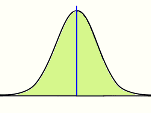
At first it looks completely random (and it is), but then you find the balls pile up in a nice pattern: the Normal Distribution.
This post is meant especially for the students of Class VIII Dear Children ,
We have enjoyed reading short stories for some time now. Here, in this post, you will find the short stories of O'Henry uploaded for your convenience, in case some of you haven't yet had the opportunity to read his works.
We have just read 'Do Not Go Gentle into That Good Night by Dylan Thomas' . This poem made familiar by the recent movie 'Interstellar' was not so difficult to understand. However, there is a lot more we can learn about Dylan Thomas himself that will help us develop a perspective of our own when we read the poem again.
(You will also find an interestingly put up timeline that tells us all about his life here and if you would like to view his works , you could do so here . )
Dylan Thomas. Born in 1914 at the start of World War I Dylan Thomas grew up to be a famous Welsh poet best known for his work Under Milk Wood, Do Not Go Gentle into the Good Night and A Child's Christmas. He was only 21 when he became the leading Anglo-Welsh poet of his time. In his poems, Dylan Thomas used words in fresh and exciting ways. He loved the sounds of words, so his poems are great for reading aloud. He wrote about his life, his friends, and about Wales. Some poems are serious, some are funny.
Catch a glimpse of the house where Dylan Thomas was born and lived until his parents moved out in 1937.This was the "…Glamorgan villa…" overlooking the "…long and splendid curving shore…" of Swansea Bay. This is where the subject of the film Edge of Love and author of Under Milk Wood spent his formative years. Dylan's birthplace has now been fully restored to its condition in 1914 when it was bought as a new house by the Thomas family.
Dylan Marlais Thomas was born in Wales on 27 October 1914. His father David John ('DJ') Thomas was an English teacher at Swansea Grammar School. His mother, Florence Williams, was a seamstress, but gave up work to look after her children. The Thomas family had a maid to help with housework.
Dylan's sister, Nancy, was 8 when Dylan was born. The family lived at 5 Cwmdonkin Drive, Swansea. Dylan had several aunts and uncles in the town. Florence spoiled her curly-headed son. If he said he felt ill, she let him off school.
'DJ' and Florence spoke Welsh, but Dylan spoke only English. The first poems he remembered were nursery rhymes. He loved the sounds of words.
Dylan started writing poems when he was 8. In 1925 he went to Swansea Grammar School. His first poem soon appeared in the school magazine. His father was in charge of the magazine!
At school, Dylan was good at English, but sometimes badly behaved. Most of all, he loved writing poetry. In 1927, he got paid for a poem by the Western Mail newspaper.
In 1930 Dylan sent some poems to Robert Graves, a famous poet. Graves liked them. Dylan was encouraged, and wrote many poems while still a teenager.
In 1931 Dylan left school. He got a job as a reporter on the South Wales Evening Post newspaper. He left next year but went on writing reviews of plays and concerts. Dylan enjoyed acting, though other actors were upset if he wrote rude things about them!
Dylan met his friends in a Swansea café, or in a pub. He loved to talk, tell stories, and read his poems aloud. He said poems should be read 'by the ears' and not just 'by the eyes'.
In 1933 he visited London for the first time. First he stayed with his sister and her husband. Then he shared rooms with friends. London was much bigger than Swansea. It was exciting to be in a city with so many writers and artists. Life as a poet
In 1934 Dylan Thomas published his first book of poems, called 18 Poems. He was becoming known as a young poet. More people read his poems, liking how he used words, and how he wrote about Wales.
In 1936, Dylan met Caitlin Macnamara, a dancer. She knew lots of writers and artists. Dylan and Caitlin were married in July 1937.
In 1938 Dylan and Caitlin moved to the small town of Laugharne, in South Wales. Their house was called 'Sea View'. In 1939, their son Llewelyn was born.
In September 1939 World War II began. Dylan was not well enough to be a soldier. When called for army interview, he went into the room looking so ill he was excused. With paper rationed, many publishing firms closed. It was hard to make money from writing. In 1943 Dylan and Caitlin had a daughter, Aeronwy. Times were hard.
During World War II, Dylan wrote scripts for films and for the BBC. The war ended in 1945. Dylan broadcast on BBC Children's Hour about 'Memories of Christmas'. He was writing some of his best poems too.
In 1949 Dylan and Caitlin moved back to Laugharne. Their son Colm was born, but Dylan and Caitlin had many quarrels.
In 1950, Dylan went to America to read his poems and talk to students. He did not like America much. When he met film star Charlie Chaplin, he drove a car across the tennis court!
In 1952 his Collected Poems were published. Dylan's parents also lived in Laugharne. When Dylan's father became ill Dylan wrote a poem to encourage him to get better, Do Not Go Gentle Into That Good Night. It is one of Dylan's most famous poems, it was also one of his last.
In 1953 Dylan went to America for the third time. He arrived just before his 39th birthday. He became very ill.
He enjoyed holidays on his Aunt Ann's farm in Carmarthenshire. Dylan's mother helped him read, and gave him comics. His father read Shakespeare to him.
In 1937 Dylan Thomas made his first radio broadcast, for BBC Wales. He talked about poetry.
Some of Dylan's poems were published in America. He wrote about growing up in stories called Portrait of the Artist as a Young Dog.
Their home, The Boat House, is now a Dylan Thomas museum. Dylan wrote in an old shed. He spent most evenings in the town's hotel, with his friends.
Dylan Thomas died in a New York hospital on 9 November 1953.
Find an analysis of the poem Do Not Go Gentle...in the video below.
The poem is structured as a villanelle with a set rhyme scheme but no well-organised meter or fixed number of syllables. A Villanelle is divided into three segments. The first segment is called the introduction. The second is called the development and the third is called the conclusion.
Here is a reading of the poem by the man himself.
And here, you could watch a biography on the poet.
We always associate a museum with History or anything related to it. But Math? Seriously. It came as a pleasant surprise to discover that there really is a Museum of Mathematics in New York.
Talk about timing! While NASA approved movie 'The Martian' gets ready to premiere on Friday, Scientists at NASA have, in reality , confirmed the evidence of water on Mars. Liquid water is essential to life and the possibility of microscopic life forms in a neighbour planet is indeed overwhelmingly exciting.
Well, Children, although the internet is teeming with news of this confirmation , you can also find out all about it here. We've lined up a video clip and some links to tell you a little more about the significance of this discovery.
Don't forget to discuss it with your teachers , family and friends.
Reposting the article from an earlier blog - written for my students back in 2013
These days understanding literature has become so much
easier what with the internet's humongous repertoire. But then, you need to
analyse every detail you read for not everything up there on the net will be
true although it may be someone's point of view put across rather strongly.
Recently , when I read 'The Highwayman' trying to identify the threads of poetic craft that ran through it,
the very experience of reading this poem filled me with wonder. Wonder at how
the poet could have taken a not-so-heroic highway robber and simply with the
help of well-crafted phrases and a thrilling romantic plot turn around our
perception of the highwayman. So our sympathies lie, not with the law, not with
what history tells us about highwaymen of the 18th century, but with the young,
dashing highwayman who is hopelessly in love with Bess, the landlord's
daughter, the man who promises to be back to his beloved , the courageous young
lover who comes riding back to seek revenge for his lady love's death, only to
die a dog's death himself. He has been betrayed by the jealous ostler Tim, who
had overheard him parting ways with Bess. Tim, whose description makes it
obvious that he is hardly our choice of a hero, is also in love with Bess but
knows he cannot get her as Bess's heart has already been won by the highwayman.
When the Highwayman enters the scene - the fact that he is
riding is emphasized by the repetition- that is what he chiefly does, rides
down the highway. Noyes describes the highwayman's appearance quite meticulously
right from the French cocked hat, the wine red coat to his brown breeches and
laced up chin, his boots, his pistol, his rapier.
We see him being described again later in the poem, but this
time he is in wild rage, as the news of Bess's tragic death has reached him.
The dark and windy night sky is painted vividly in striking
metaphorical language
'The wind was a torrent of darkness among the gusty
trees.
The moon was a ghostly galleon tossed upon cloudy seas.
The road was a ribbon of moonlight over the purple moor...'
In the dark of the night does all the action take place. The
moonlight is ghostly, shadowy - hardly able to survive the clouds- like a ship
being tossed about by the waves in the sea.The setting foreshadows the tragic
events that are to happen soon.
One more character that stays with us is Bess. She gives up
her life for the man she loved. True love for years has been elevated to fame
with the death of lovers. But in this poem the lovers meet, although it is after their death. For even now in the
moonlight one can hear the highwayman come riding, riding, riding...
I enjoyed my experience of reading The Highwayman thoroughly
and am sure all my students who read it with me did.
Here are some links that I chanced upon while looking up the
poem.
For the following grammar test you give yourself for
practice - you are supposed to complete this in 20 minutes. Can you do it and
manage to ace it as well? Try it! You may set yourself marks for this on your
own... :)
Question 1
You must do as you have been directed in the brackets...
i. Sona bit into a
delicious chocolate cake. [Begin: The cake…]
ii. Rajiv failed to
score high marks in the test. [Change into a negative sentence]
iii. Being innocent, my little brother does everything he is
asked to do if we call him 'superhero'.
[ Use; so…. that]
iv. Preeti ought not to have hidden the picture when she
found it. ( It was wrong...)
v. As soon as the I reached the bus stop, everyone crowded
around me. [Begin: No sooner…..]
vi. “You need to have breakfast everyday or else you won't
be able to concentrate for long.” My class
teacher said. [Change into indirect speech]
vii. This is the best novel I have ever read. [Begin:
Never…]
viii. Sheetal painted a
beautiful portrait of her aunt. [Change the voice]
Question 2
Use appropriate words
to complete the sentences given
i. The doctors at Red
Cross discovered a drug to cure him ______________ the rare disease.
ii. I am certain the
Director will disapprove __________ our decision.
iii. Do you think you will benefit ___________ my
advice?
iv. We all can
distinguish true praise _________ flattery.
v. Rajan find it difficult to be attentive_______________
what is being taught.
Question 3
Use an appropriate form of the verb given ....any tense you
think suits the sentence
i. If he …………….. (has) the money , he would buy it now.
ii. A man of high principles never …………………..(break) his
word.
iii. I shall be very surprised if it …………………….(rain) any
more.
iv. If I had ………………………….(know) you were coming, I would have
baked a cake.
We have disagreements all the time in real life. So it is
with grammar too!
What we call rules can easily be remembered if we think of
the words as behaving exactly like us, humans. They are close friends with some
and at loggerheads with others.
Thus we come to that slippery subject Subject -
Verb Agreement which often slips in unnoticed in many an English
Language test paper and leaves us ruffled.
Let's get the facts clear first-
What is subject - verb agreement?
Take the example of ...
Shirin goes to school with her sister.
The subject in this sentence is Shirin as we are talking
about Shirin in this sentence.
The verb is 'goes' since the subject is singular.
If the subject had been Shirin and her sister, then we would
have to use the verb 'go', and the sentence would have been written as
follows:-
Shirin and her sister go to school.
So the verb in a sentence has to agree with the subject.
Let's see if we can do the following Subject - Verb
exercise. Warning: These are real tricky ones!
Fill in the blanks with an appropriate verb
( Clue:Go for the subject right next to the verb. The verb
agrees with it.)
i) There _________ a cupboard and a bed in this room.
ii) Either the writers or the publisher _____________ to
blame.
iii) The minister and the painter ______________ coming.
iv) The team __________ done a good job.
v) The pair of
scissors ___________ on the desk.
vi) The committee _____________ working on the issue.
vii) Neither the students nor the teacher _____________
enjoying the show.
viii) Neither the students nor the teachers ___________
enjoying the show.
ix) Which of those charts ______________ yours?
x) The costume with all its accessories _______________
reached the salon.
To think that someone who has been through so much in life can be so positive that she inspired people across the globe, not only as long as she lived but now even after she's passed away. Truly a phenomenal woman!
Really, what a wonderfully thought - provoking poem have we read together, Class XI! I hope you've been prodded to read more about Dr. Maya Angelou after reading it.
Here, for you is the poem recited by none other than the poet herself. Listen and enjoy!
To understand the kind of person she was - even just a bit you must listen to what she has to say about humane qualities that exist in all of us. 'I am a Human Being!' She reaffirms.
If you want to take a walk through her life, listening to what she has spoken to millions the world over about, watch this documentary that speaks volumes about her-
If you would like to know a little more about her, here's a film that takes you back in time.
Angelou speaks about her childhood in this video.
Do listen to these and let us share in class what more you have found out about Maya Angelou . What did you find fascinating about her life and her work?





.png)